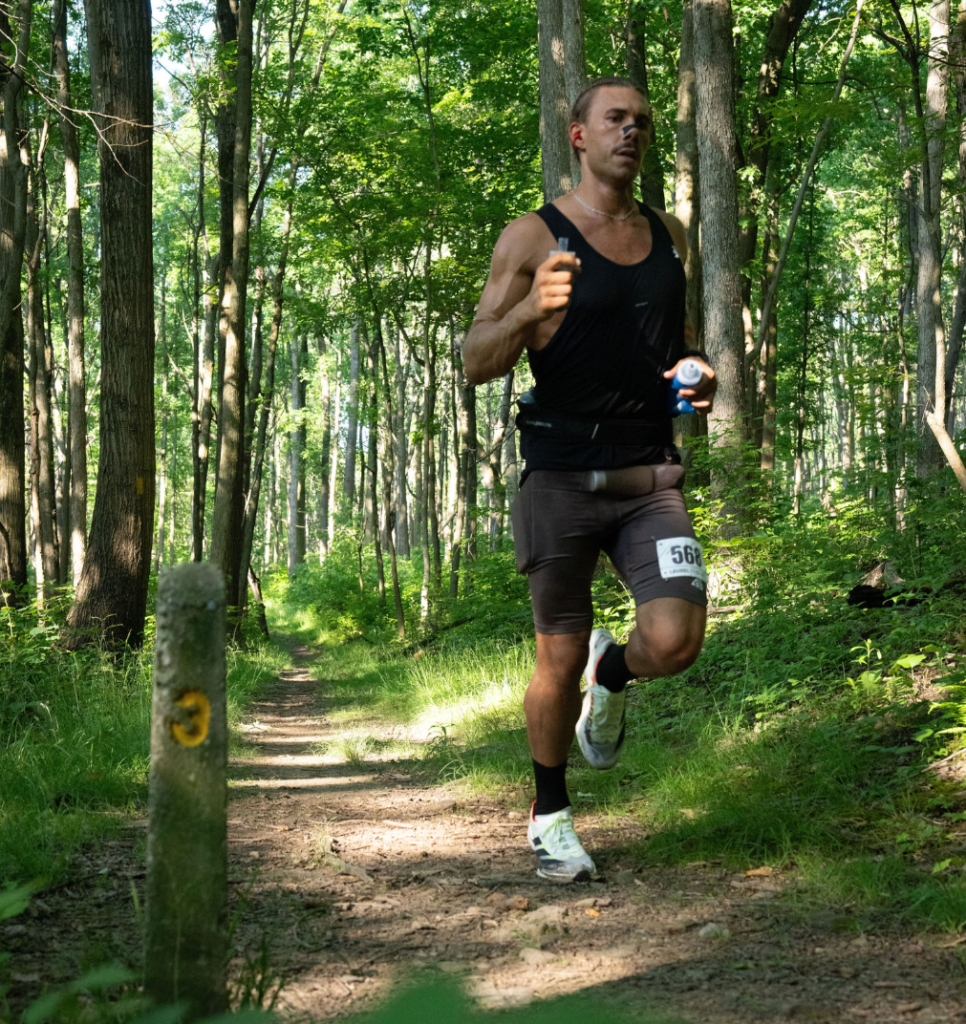
I woke up on race morning feeling absolutely nothing.
Not nervous. Not excited. Not anxious. Not even particularly motivated. Just empty.
It was a strange feeling because years ago race mornings felt completely different. I’d spend hours thinking about the course, wondering who would show up, imagining worst-case scenarios, convincing myself I wasn’t ready. Somewhere along the way that disappeared. Maybe it was because this was already my fifth ultra of 2026. Maybe it was because I’d raced seven ultras since November. Maybe it was because after enough starting lines, they stop feeling like events and start feeling like another day at work.
Whatever it was, I felt calm.
The kind of calm that only comes from repetition.
Outside my hotel room sat 31 miles of trail and 6,500 feet of climbing through the woods of Pennsylvania. Laurel Highlands isn’t one of those races people post photos of because the views are breathtaking. There aren’t mountain ridges that stop you in your tracks. There aren’t moments where you turn a corner and stand in awe of the landscape around you.
It’s dirt. Rocks. Roots. Grass. Long stretches of trail disappearing into the woods.
A hard race.
That’s what attracted me to it.
After racing in Arizona earlier in the year and getting humbled by 5,000 feet of climbing, I knew this course would be difficult. Living in New York City doesn’t exactly provide ideal conditions to train for sustained mountain climbing. You can run all the miles you want, but eventually there are specific demands that only mountains can teach.
Still, standing there that morning, none of it felt overwhelming.
I had already done the work.
For months I’d been stacking week after week of 100 to 130 miles. Not because I loved every run. Not because every workout felt amazing. Because I knew that eventually I would find myself in situations exactly like this one and I wanted to trust myself when they arrived.
That’s really what this race taught me.
Trust yourself.
People throw that phrase around all the time. Trust yourself. Believe in yourself. Have confidence.
But where does trust come from?
It doesn’t come from motivational quotes.
It doesn’t come from positive thinking.
It comes from evidence within your training.
Trust comes from knowing what you’ve done when nobody was watching.
It comes from the early mornings, the double runs, the long weeks, the sacrifices and consistency. Trust is earned.
Standing at the starting line, surrounded by 160 runners, I felt completely alone. Not in a bad way. In the best way possible.
Nobody knew me.
Nobody expected anything from me.
Nobody was asking questions.
Nobody was trying to talk strategy.
It was just me and the race.
I looked around at the field the same way I always do. Some runners looked excited just to be there. Some looked nervous. Some were there to compete. A few looked like they were there to win.
My plan wasn’t complicated.
Compete.
The gun went off and almost immediately a small group surged to the front. Five runners took off at a pace that looked completely unreasonable given what waited ahead. Watching them disappear up the trail, I remember thinking, this is going to be a very long day.
The opening miles felt controlled. I settled into third place and focused on staying relaxed. The first major climbs arrived quickly. Laurel Highlands is known for its opening eleven miles, particularly the three major climbs that account for roughly 3,000 feet of elevation gain before the race is even halfway underway.
The climbing started doing what climbing always does. It exposed weaknesses.
One runner passed me.
Then another.
Then another.
I wasn’t running poorly. They were simply climbing better.
For years that would’ve bothered me. This time it didn’t.
Because I wasn’t racing mile five.
I was racing mile thirty-one.
There’s a huge difference.
The deeper I got into the climbs, the more patient I became. I watched runners attack sections of trail that didn’t need to be attacked. I watched others force the pace. Every time somebody passed me, I reminded myself that the race wasn’t happening yet.
The race would happen later.
The race would happen when fatigue arrived.
The race would happen when fueling mistakes started showing up.
The race would happen when durability became more important than speed.
Around mile twelve I hit the ground hard.
Trail running is funny that way. One second you’re moving well and the next you’re staring at dirt wondering what just happened. The fall rattled me and left me trying to regain momentum. Then another mistake. Another awkward step. Suddenly I found myself sitting in twelfth place.
Twelfth.
On paper that sounds terrible. In reality, I didn’t care.
The funny thing about ultras is that position rarely tells the story.
I’ve learned that most runners aren’t beaten by the course. They’re beaten by their own decisions. They go out too hard. They underfuel. They underestimate the demands of the day. They spend energy they can’t afford to spend.
So I kept moving.
Eventually I linked up with another runner and for several miles we worked together. The conversation was easy. The pace was steady. Without realizing it, we started passing people.
One runner.
Then another.
Then another.
Every pass looked different. Some runners were cramping. Some were slowing. Some simply looked tired.
The further we moved into the race, the more obvious it became that patience was paying off.
By mile seventeen my running partner’s calf began locking up. We’d spent enough time together talking about fueling and hydration that I already had a pretty good idea what was happening. He wasn’t taking in enough sodium. He wasn’t drinking enough. The bill had finally arrived.
That’s the thing about ultras.
Every decision eventually shows up.
You can’t negotiate with the course.
You can’t negotiate with dehydration.
You can’t negotiate with poor fueling.
Eventually the truth catches up.
Now I was alone again.
Exactly how I like it.
The final third of an ultra is one of my favorite places on earth. The noise disappears. The nerves disappear. The race becomes incredibly simple. Move forward. Eat. Drink. Stay focused.
By the time I reached the final aid station at mile twenty-six, I felt surprisingly strong.
Not fresh.
Strong.
There’s a difference.
Three runners who had passed me hours earlier were standing there. One looked over and laughed.
“Wow, you caught us.”
I smiled.
They had no idea.
This is why I love ultras.
You are never out of the race.
Ever.
Not when you get passed.
Not when you fall.
Not when you’re sitting in twelfth place.
Not when things aren’t going your way.
I knew exactly how I felt. I knew exactly how much fuel I’d taken in. Nearly 170 grams of carbohydrates per hour. Around 50 ounces of fluid every hour. Roughly 2,000 milligrams of sodium. While other runners were beginning to fade, I felt steady.
The gap between us wasn’t fitness.
It was preparation.
They left the aid station two minutes before I did. I filled my bottles, took a deep breath, and immediately followed.
For about a mile we moved in single file through the woods. Nobody spoke. Nobody attacked. Everybody waited.
Then I felt it.
Not confidence.
Certainty.
The certainty that comes from preparation.
I trusted my training.
I trusted my fueling.
I trusted the thousands of miles I’d run.
Most importantly, I trusted that I was stronger than I had been six months ago.
So I went.
The pace picked up immediately. Tall grass brushed against my legs. Rocks hid beneath the surface. The trail twisted through the woods. Every few minutes I’d glance over my shoulder and see the gap slowly growing.
The effort hurt.
Good.
It was supposed to.
This was the race.
Not the climbs.
Not the opening miles.
Not getting passed.
This.
The final push.
The final test.
Holding pace through terrain that demanded every ounce of concentration.
With one mile left, I stopped worrying about the runners behind me and started appreciating where I was.
A few months earlier I was dealing with another AFib episode. There were questions about training. Questions about racing. Questions about what came next.
Now I was closing out my fifth ultra of the year.
Still moving.
Still competing.
Still learning.
The finish line eventually appeared through the trees and I realized something.
The race had never really been about second place.
It wasn’t about the podium.
It wasn’t about passing runners late.
It wasn’t even about proving something to other people.
It was about trust.
Trusting that the work matters.
Trusting that consistency matters.
Trusting that if you keep showing up long enough, eventually you’ll become the person capable of handling difficult days.
I crossed the finish line in second place out of 160 runners, but the result wasn’t what stayed with me.
What stayed with me was the realization that throughout the entire race I never panicked.
Not when people passed me.
Not when I fell.
Not when I dropped to twelfth.
I simply kept moving.
Like water.
Steady.
Patient.
Always finding a way forward.
And in the end, that was enough.