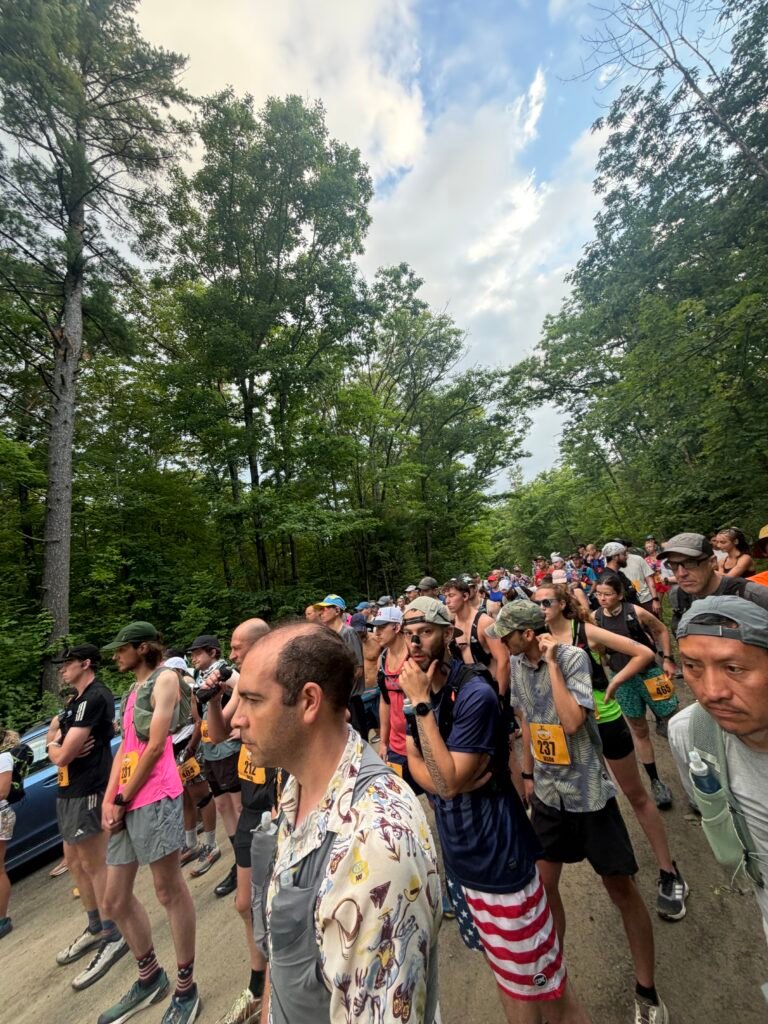
And that’s why this year was never about a single race….Finger Lakes was my sixth ultra of the year and my second consecutive second-place finish, but if you think that’s what this story is about, you’re missing the point.
I stood on that start line with nearly 70 miles already in my legs from training. Most people would look at that and think it’s a mistake. Why would you intentionally show up carrying fatigue? Why not taper perfectly and chase the best possible performance?
Because not every race deserves to be your best race. One of the biggest mistakes endurance athletes make is believing every race has to be an “A” race. For me, It doesn’t. Some races exist to teach you how to execute. Some teach you patience. Some expose weaknesses. Others simply harden your body and your mind when you’re pushing for 100ks, 100 milers and 200 milers.
I have a goal later this year that I haven’t announced yet, and it’s big enough that every decision I make has to serve it. Someone running twelve ultras in a single year while averaging well over 100-mile weeks isn’t treating every 50K like it’s the biggest day of their life. I’ve always wanted something bigger than one good race. I want to become the type of athlete who can keep showing up, race after race, month after month, until the opportunity that truly matters arrives.
Race morning greeted us with exactly what I was hoping for and exactly what most runners were dreading.
Humidity.
Around 90% humidity with a dew point hovering around 68 degrees. Those numbers don’t sound intimidating until you understand what they do to the human body. Sweat cools you only when it evaporates. In humid conditions, that evaporation slows dramatically, meaning your body traps more heat, your heart has to pump harder to move blood to both your muscles and your skin, and your perceived effort climbs long before your pace changes. That’s why races in humidity often become survival contests instead of fitness contests.
Ironically, I wanted it hotter. Heat has become something I intentionally prepare for because I believe the greatest separator in ultras isn’t who can run the fastest when everything is perfect—it’s who can keep making good decisions when nothing feels good anymore.
The gun went off and, like almost every ultra, people forgot it was an ultra.
The first few miles rolled by around 6:45 pace as everyone sprinted toward a finish line that was still nearly four hours away. I tucked myself into the front group but stayed patient. Early in races I like talking to people. I’ll casually ask how they’re fueling or what they’re drinking. Those conversations aren’t just conversations—they tell you how someone expects their day to unfold. In hot, humid races, small mistakes become massive mistakes twenty miles later.
The Finger Lakes course has a personality of its own. It isn’t just miles on a GPS watch. One minute you’re weaving through dense woods under a thick canopy where the air somehow feels even heavier. The next you’re climbing slopes before dropping into muddy singletrack that tries to steal your shoes with every step. Then suddenly you’re running through open farm fields, weaving between cows that seem completely unimpressed by hundreds of runners passing through their backyard.
Unfortunately, the cows leave souvenirs.
By the end of the day my shoes had collected enough mud, cow manure, and cow urine that I stopped caring what I stepped in. That’s trail running. Nobody tells you that in the highlight reels. You spend months preparing your body only to realize you’re going to spend five hours covered in dirt, slipping through mud, smelling like a farm, and somehow loving every second of it.
Around seven miles in I was sitting in sixth place. Calm. Patient. I knew the climbing would naturally spread the field out. Four thousand feet of elevation is still an area where I know I can improve, so there was no point pretending I was someone I wasn’t. One of the most valuable lessons racing has taught me is to compete with honesty. Know your strengths. Respect your weaknesses. Then execute anyway.
By mile twelve, patience started paying dividends. The runners who attacked the opening miles began fading. They weren’t less fit. They had simply borrowed energy they couldn’t afford to spend. That’s one of the most beautiful things about ultras. The race eventually asks everyone the same question: Did you prepare for this moment, or did you prepare for the first hour?
I kept moving.
Lap two found me sitting in third place. At an aid station I asked how far back I was. “15 min”
“are you fucking serious” people would think I’d be mad saying that…it was more or less sarcasm of me doing that math in my head to know I would have to cut down 2/3 min per mile to catch the winner.
From that point on, I realized I didn’t need to do anything spectacular. I didn’t need to chase anyone. I simply needed to continue doing exactly what I had practiced for months, moving efficiently, fueling consistently, and respecting the course. “Be water”. Keep moving.
Around mile twenty-four, we climbed a long road section and I spotted Seb in the distance. Earlier in the day I thought he was on pace to run close to four hours. When I finally caught him, I asked if he was okay.
“The heat,” he replied.
That moment stuck with me because I realized I hadn’t been thinking about the weather anymore.
Not because it wasn’t hard.
Because preparation changes your relationship with discomfort.
People often think toughness means not suffering. It doesn’t. Toughness means you’ve suffered enough in training that suffering no longer surprises you.
A friend asked me recently if I ever wake up and don’t want to run.
Honestly, no.
Not because every run is exciting. Not because every workout is fun. But because I’ve learned something most people spend years avoiding: the uncomfortable days are the ones that change you. Give me the high-mileage weeks. Give me the climbs. Give me the weather everyone complains about. Every difficult day becomes another deposit into an account I’ll cash in later, even if I can’t see the balance today.
The final miles gave me something ultras rarely do, time to think. “what a day”. I realized that almost every finish line is the same for me. I cross it alone. No big celebration. No crowd waiting. Just another reminder that the work happened long before anyone was watching.
The podium was nice. The second-place finish was nice. But six months from now, nobody will remember what place I took at Finger Lakes, not even me. Thats why i’m pissed. No one expected that. Let’s be honest. These arent major races..but as I say…the work will take care of you and one day will be your turn.
I’ll remember the humidity. I’ll remember the mud. I’ll remember running through the woods, across cow fields with manure and urine soaking through my shoes, asking strangers about their fueling, passing runners who gambled too early, and realizing once again that preparation is invisible until it isn’t.
The race ended the moment I crossed the finish line.
The training didn’t….