There’s a lie we tell ourselves, especially in endurance sports, and it’s subtle enough that most people never question it. The lie is that progress is supposed to feel good. That if you’re doing things “right,” you’ll wake up motivated, energized, and ready to perform at a high level every time you lace up your shoes. The lie is that consistency should feel consistent.
It doesn’t.
Your best looks different every day. And the moment you accept that, everything changes.
This year, I’m running twelve ultramarathons in twelve months. Distances ranging from fifty miles to two hundred. Some races will be defined by time limits, some by terrain, some by sleep deprivation, and some by nothing more than stubbornness. On paper, it sounds clean. Ambitious. Almost heroic. In reality, it’s messy, uncomfortable, and largely built on days where nothing feels right.
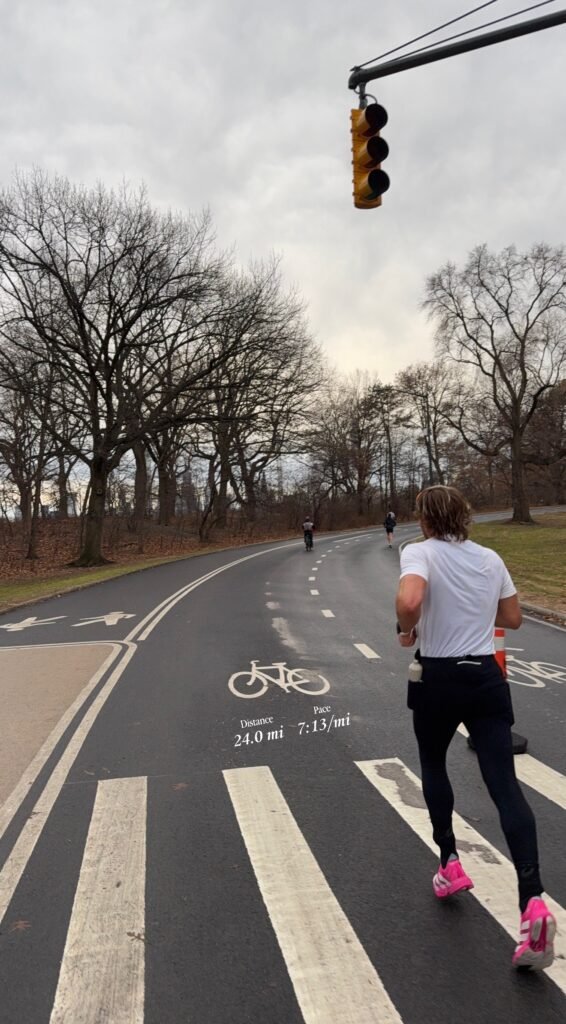
I’ve been training at volumes most people would consider unreasonable. Ninety-five to one hundred miles a week. Back-to-back weeks like that. Layering speed work on top of it, not because it’s comfortable, but because it’s necessary. There are days where I finish a run and think, I feel good. And then there are days where everything feels heavy before the first mile is done. That’s not a problem. That’s the deal.
We’ve been conditioned to believe that a bad workout is a failure. That if we don’t hit our splits, or our heart rate is off, or our legs don’t feel springy, then something went wrong. Social media has made it worse. Every scroll reinforces the idea that everyone else is crushing it all the time. Fast workouts. Perfect pacing. Smiling faces at the end of hard sessions.
What you don’t see are the days where effort feels disproportionate to output. Where seventy percent effort is all that’s available, and even that feels expensive.
Here’s the truth most people don’t want to hear: those days matter more than the good ones.
In ultrarunning, you don’t get to choose how you feel on race day. You don’t get to negotiate with fatigue at mile eighty. There is no alternate course for days when your body doesn’t cooperate. Some races feel smooth. Most don’t. Some miles feel controlled. Many feel like survival. The athletes who succeed are not the ones who demand perfection. They’re the ones who’ve practiced showing up when perfection isn’t an option.
That’s why your best has to be flexible.
A ten-out-of-ten day doesn’t mean the same thing every time. Some days, your best is flying. Other days, your best is simply continuing. And sometimes, your best is lacing up when every internal voice is telling you to skip it.
I’m tired of hearing people complain about “bad workouts.” About how they only had seventy percent instead of one hundred. As if effort owes them a certain feeling. As if discomfort is a mistake instead of the point.
If you’re training for something real, something that actually tests you, most days won’t feel good. And that’s not a warning. That’s a prerequisite.
The winners, the ones who last, are rarely the loudest. They don’t broadcast every struggle. They don’t narrate every bad session. They show up, do the work, and move on. They understand that effort isn’t a performance, it’s a habit. On the worst days, they give what they have, even if what they have is ten percent. Especially then.
Because some races feel exactly like that.
You wake up flat. Nutrition is off. Sleep didn’t happen. Weather turns. Legs don’t respond. And suddenly the day you trained for months to execute becomes an exercise in managing disappointment. That’s not failure. That’s sport. That’s life.
We like to pretend life is linear. That if you work hard enough, outcomes smooth themselves out. But anyone who’s chased something difficult knows better. Progress comes in waves. Motivation fades. Confidence dips. Bodies ache. Plans unravel.
And yet, here you are.
Two weeks from now, I’ll line up for the first ultra of the year. A six-hour race where the only goal is to cover as much ground as possible in the time allotted. It’s not about pace. It’s not about glory. It’s about time on feet. About learning how to keep moving when comfort is unavailable. February brings a fifty-miler. And after that, it doesn’t get easier. It gets longer.
Twelve ultras won’t run themselves. The training doesn’t do itself. And I won’t feel good one hundred percent of the time. In fact, I’ll probably feel bad more often than I feel good. That’s not pessimism. That’s realism. And realism is freeing.
Because once you stop demanding that every day feel good, you stop quitting on the days that don’t.
You stop interpreting discomfort as a signal to stop. You stop attaching your identity to metrics that fluctuate. You stop turning normal human variance into a personal crisis.
You start to understand that bad days are not interruptions. They are the curriculum.
Falling in love with the process doesn’t mean enjoying every moment. It means respecting the role of the hard ones. Embracing the awful days. Not with fake positivity, but with acceptance. This is what today feels like. This is what I have. Let’s work.
That mindset applies far beyond sport.
Careers stall. Relationships strain. Confidence erodes. There are seasons where effort doesn’t immediately reward you. Where progress is invisible. Where the work feels thankless. Most people retreat in those moments. They wait to feel better before acting. They wait for motivation to return.
The people who grow don’t wait.
They adjust their definition of success for the day and keep going.
Some days, your best is aggressive. Some days, it’s quiet. Some days, it’s relentless. Some days, it’s patient. All of it counts.
Ultrarunning just strips away the illusion faster. It forces honesty. You can’t fake your way through a hundred miles. You can’t negotiate with fatigue for two hundred. You either accept reality and work within it, or you break.
And that’s the real lesson behind this year.
Not that I’m running twelve ultras. Not the distances. Not the numbers. The lesson is learning to show up without guarantees. To commit without knowing how each day will feel. To build a life and a body that can tolerate inconsistency without losing direction.
Your best looks different every day. That’s not a weakness. That’s the rule.
Once you accept it, you stop wasting energy wishing for better conditions. You stop resenting hard days. You stop measuring yourself against unrealistic standards.
You show up. You do the work. You move forward.
Even when it’s awful.
Especially then.